Working men's bodies by John Field
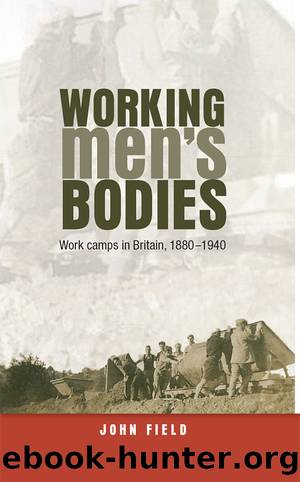
Author:John Field [Field, John]
Language: eng
Format: epub
Tags: History, Social History, Social Science, Men's Studies
ISBN: 9781526112521
Google: qnC5DwAAQBAJ
Publisher: Manchester University Press
Published: 2016-05-16T00:44:51+00:00
Inside the TICs
Other than the risk of lice, what did young men face when they were drafted into the TICs, and how did they react to the experience? Members of a Lancashire employment committee who visited Presteigne in 1930 reported that the men lived in huts with boarded floors, where each man had âa wooden trestle bedstead, a mattress and five blanketsâ. Usually, new arrivals were picked up at the nearest railway station, having received a travel warrant from the Ministry to cover the journey from their home. They were interviewed on arrival in the camp, and then sent to their sleeping quarters, where each man collected a knife, fork, spoon, mug, boots and pair of corduroy trousers; a jacket and shirt were also supplied for ânecessitous casesâ, who â unsurprisingly given that these men had been out of work for some time â were the majority. In wet weather, the men drew oilskin cloaks from the camp stores. Two coal stoves burnt all night, and there was hot water for washing, as well as hot and cold showers. The men received four meals a day.68
In spite of the medical test, the camp managers quickly started reporting that many of the men were too undernourished and unfit to cope with pick-and-shovel work. After a week or two of light work, most of the men were âgiven more and harder work to do, being moved from one carefully graded gang to another until the last weeksâ. By this stage, they were judged suitable for the âheavy navvy workâ on the land that was the TICsâ raison dâetre.69 Trainees spent most of their weekdays working outside, digging ditches, grubbing up roots, shifting stones and building rough forest roads, for seven hours, though they also received some instruction in ârough carpentryâ, basic metalwork, and boot and shoe repair.
For leisure, there were sports and games: the Ministry had asked the Sports Fellowship to help it recruit sports instructors.70 After the early days, there were also occasional lectures, organised by the camp welfare officer, as well as a library with 300 novels, magazines and daily papers, and sets of games in the recreation room. Presteigne, according to the Lancashire visitors, also had its own projector, with weekly shows involving the likes of Charlie Chaplin, Harold Lloyd, and other popular stars.71 The authorities provided some limited and rather basic adult education, âboth for its own sake and to help solve the problem of keeping the men occupied in wet weatherâ.72
All trainees received a weekly allowance. Those who lived at home were paid their benefit, and an additional 2s. 6d. weekly; single men who stayed in lodgings were given 5 shilling weekly out of their benefit, with the remainder being held back against the costs of their food and accommodation. In the residential TICs, all the men received an allowance of 4 shillings weekly. Married men in the TICs were eligible for an additional allowance for their families, though it was left to the man to decide whether he would send the money home.
Download
This site does not store any files on its server. We only index and link to content provided by other sites. Please contact the content providers to delete copyright contents if any and email us, we'll remove relevant links or contents immediately.
The Vikings: Conquering England, France, and Ireland by Wernick Robert(84284)
Ali Pasha, Lion of Ioannina by Eugenia Russell & Eugenia Russell(40281)
The Conquerors (The Winning of America Series Book 3) by Eckert Allan W(37485)
The Vikings: Discoverers of a New World by Wernick Robert(36989)
Cecilia; Or, Memoirs of an Heiress — Volume 1 by Fanny Burney(32590)
Cecilia; Or, Memoirs of an Heiress — Volume 2 by Fanny Burney(31972)
Cecilia; Or, Memoirs of an Heiress — Volume 3 by Fanny Burney(31951)
Empire of the Sikhs by Patwant Singh(23097)
The Secret History by Donna Tartt(19155)
Hans Sturm: A Soldier's Odyssey on the Eastern Front by Gordon Williamson(18609)
Cat's cradle by Kurt Vonnegut(15388)
Pimp by Iceberg Slim(14550)
Sapiens: A Brief History of Humankind by Yuval Noah Harari(14410)
Talking to Strangers by Malcolm Gladwell(13397)
Norse Mythology by Gaiman Neil(13393)
Leonardo da Vinci by Walter Isaacson(13356)
4 3 2 1: A Novel by Paul Auster(12429)
Underground: A Human History of the Worlds Beneath Our Feet by Will Hunt(12110)
The Radium Girls by Kate Moore(12049)
